A UGC rate card is the list of what you charge; a media kit is the one-page intro that goes around it (bio, niches, formats, past brands, a few stats). As of October 2026 my card says $350 for one video, $900 for three, +$100 per 30 days of paid usage, $150 per 30 days for whitelisting, $450 for a Reel posted on my account and $200 for a five-photo set. I almost never attach the file: when a brand asks for rates I paste three lines of text into the email or DM, and on platforms like Insense the campaign budget sets the price anyway.
Okay, the rate card. The first time a brand asked “what are your rates?” I had nothing ready and spent a whole evening in a panic, which is mistake number one on my list. So this is the document I wish I’d had on day one: what’s on my media kit, the exact numbers on my rate card as of October 2026, what I don’t charge for, and the slightly unglamorous truth about how I send it (text, not PDF).
Rate card vs media kit: what’s the difference?
A rate card is your price list. One video, a bundle, and the add-ons.
A media kit is the page around it: who you are, what you film, which brands you’ve worked with, and a couple of numbers that show you’re real. Mine is a single page made in Canva, and the rate card is one row of it.
Brands rarely ask for the kit. They ask for rates. The kit exists for the moment someone on the brand side says “can you send me something I can forward to my manager?”
What’s on my media kit (the real one)
Here’s mine, with the prices blurred because they’re in the text below anyway and the email hidden:
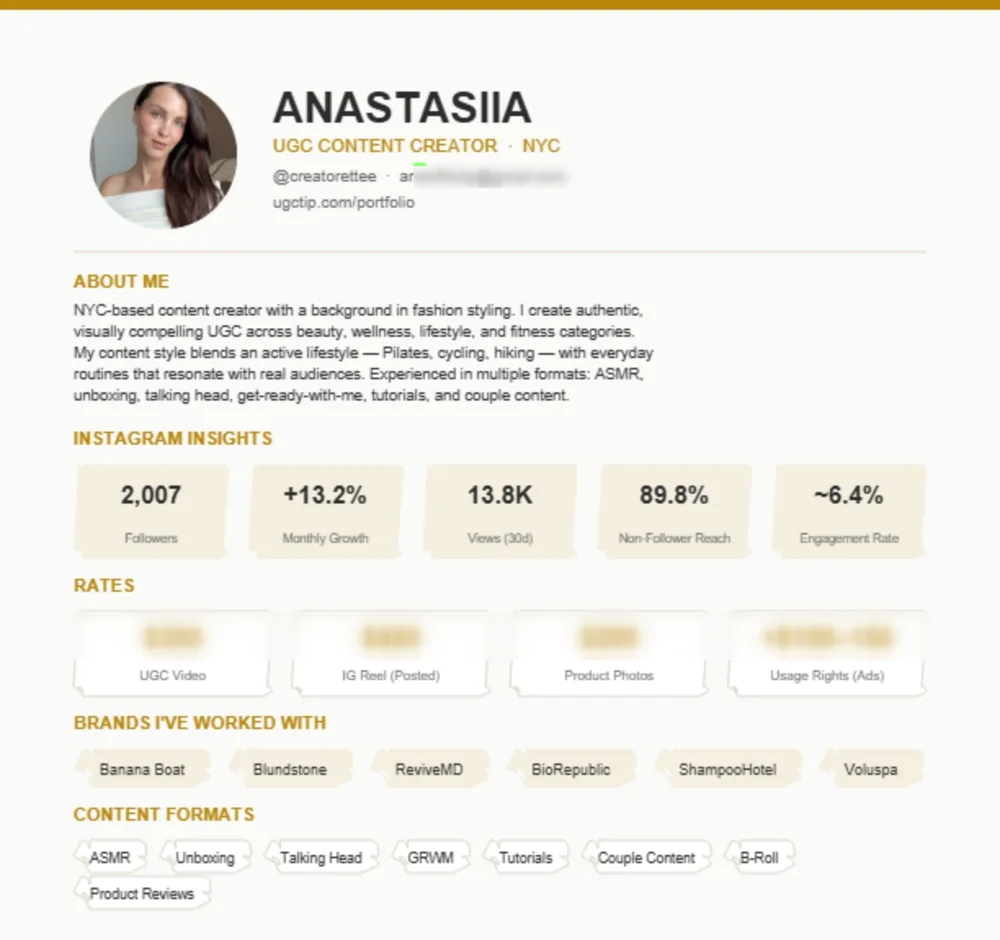
Top to bottom:
- Name, title, city, handle, portfolio link. “UGC content creator · NYC”. The portfolio link is this site’s portfolio page, not a Canva site, because brands click it from their phone.
- About me, five lines. NYC, fashion-styling background, the categories I film (beauty, wellness, lifestyle, fitness), what my content looks like (an active, everyday life) and the formats I do.
- Instagram insights. About 2k followers, monthly growth, 30-day views, the share of reach that comes from non-followers (almost 90%) and engagement (around 6%). I’ll say more about why these are there in a minute.
- Rates. The four main numbers.
- Brands I’ve worked with. Six logos’ worth of names.
- Content formats. ASMR, unboxing, talking head, GRWM, tutorials, couple content, B-roll, product reviews.
That’s it. No “mission statement”, no three pages of stats. A brand’s influencer manager looks at this for twenty seconds.
Why Instagram numbers are on a UGC kit at all
UGC is content for the brand’s channels, so my follower count doesn’t matter for the job. I keep the stats on the kit for one reason: they prove the account is real and active, and the “non-follower reach” line quietly says “my videos travel beyond my own audience”, which is the same skill the brand is buying. If your numbers are tiny, leave them off. A kit with no stats is better than a kit that apologises.
My rate card as of October 2026
| Line | Price |
|---|---|
| One UGC video (15–60 s, 9:16, captions, two hook variations) | $350 |
| Three-video bundle | $900 |
| Paid usage rights (brand runs the video as an ad) | +$100 per 30 days, or +$150 per 90 days |
| Whitelisting / Spark Ads (ad runs from my account) | $150 per 30 days |
| Reel posted on my own Instagram | $450 |
| Product photo set (5 photos) | $200 |
A few notes, because the table alone is misleading:
- Returning clients pay less. I have a “returning partner” rate that never goes below $300 per video or $800 for three. Repeat work is the easiest work, and I want brands to come back.
- The $350 is not where I started. By the end of my third month I was at $100–$200 per video. What moved the number was platform campaigns and repeat bookings, not a braver email. The full story of the ranges is in my rates guide.
- On platforms the card doesn’t apply. On Insense and Cohley the campaign sets a budget range and you bid inside it. My card is for direct deals: cold email, brand forms, DMs and inbound.
- Usage is always a separate line. Organic use (the brand’s own feed) is included; ads are not. If you take one thing from this page, take that. Why, in detail.
What I don’t charge for
This surprises people. On my card there is no:
- Rush fee. If I can do it fast, I do it. If I can’t, I say so and we move the date.
- Extra hook fee. Two hook variations are included in every video. A third one is a conversation, not a line item.
- Raw footage fee. Raw is usually part of the brief on platform campaigns anyway, so I stopped pretending it was an add-on.
I’m not saying don’t charge for these. Plenty of creators do, and the rates article shows the typical percentages. I’m saying my card is short on purpose: four numbers a brand can say yes to in one reply.
How I actually send it (text, not PDF)
Here’s the part most “media kit template” posts skip. I almost never send the file.
When a brand asks for rates, by email or Instagram DM, I paste something like this:
Here’s how I usually work: – 1 UGC video (15–60 s, captions, 2 hook options): $350 – 3-video bundle: $900 – Paid usage for ads: +$100 per 30 days Organic use on your own channels is included. Happy to adjust the package to what you need!
Three lines and a sentence. Reasons:
- Replies come faster. A brand answers text in the same thread. An attachment gets “downloaded later”, which is brand-speak for never.
- Instagram can’t take a file. Half of my direct conversations start in DMs.
- The price is already visible. If the numbers are in the text, the kit adds nothing except a nicer font.
The kit goes out when someone asks for it, or when a brand says “send me something to share with the team”. Then it’s the PDF, and the prices on it match the text I already sent. When the ask is a post on my own account rather than a video for theirs, the numbers and the disclosure rules are different; that is paid partnership on Instagram explained.
When to send rates at all
Never in the first email. My pitch (the template is here) asks one question and links the portfolio; the rates wait until a brand shows interest. Sending a price list to someone who hasn’t said “tell me more” reads as a catalogue, not a conversation.
Once they ask, send the three lines the same day. The longer a brand waits for a number, the more likely their budget goes to a creator who answered.
Rate card template: the format and a filled sample (build yours this week)
The format is the same whether you call it a UGC rate card, an influencer rate card or a content creator rate card: one line per deliverable, one price, one short note on what it includes. Here is the template with a filled sample next to it, so you can see how little it needs to be:
| Line on the card | Template | Filled sample (a creator a few months in) |
|---|---|---|
| One UGC video (15–45 s) | $___ · includes [n] hooks, organic use [days] | $150 · 2 hooks, organic use 90 days |
| Three-video bundle | $___ · same terms, one product or three | $400 · one brand, three formats |
| Paid usage (ads) | +$___ per 30 days | +$50 per 30 days |
| Whitelisting / Spark Ads | +$___ per 30 days | +$75 per 30 days |
| Posted Reel on my account | $___ (only if you have an audience) | leave blank until you do |
| Extras | raw footage / rush / extra hook: included or $___ | 2 hooks included, raw footage on request |
| Terms | 50% to book, 50% on delivery · [n] revision round | 50/50 · one revision round |
Swap the sample numbers for the step of the gifted-first ladder you are on; mine as of October 2026 are above.
- Put three numbers on it: one video, a bundle, usage per 30 days. You can add Reels, photos and whitelisting later.
- Price the deliverable, not your follower count. Here’s the formula I use, and the rate calculator does it for you.
- Keep the kit to one page and the “about” to five lines.
- Write the text version first. That’s the one you’ll send fifty times.
If you’d rather fill in blanks than design a page, my fill-in rate card template is the free download at the bottom of this page: a one-page guide to what to type in each field, and a card with no ugctip branding that you can send to brands as is.
Frequently asked
What is a UGC rate card?
A short list of your prices: per video, per bundle, and the add-ons like paid usage rights, whitelisting, extra photos or a post on your own account. It exists so you never have to invent a number on the spot when a brand asks.
What is the difference between a UGC media kit and a rate card?
The media kit is the one-page introduction: who you are, what you film, which brands you've worked with and a few audience numbers. The rate card is the price list. Mine are on the same page, but the rates are the part brands actually ask for.
Do UGC creators need a media kit?
Not to get started. I got my first paid videos with a portfolio link and a rate typed into an email. A media kit helps later, when a brand's team wants one document to pass around internally.
Should I put my rates in the media kit?
Yes, but keep the kit as a backup. In practice I send rates as plain text in the email or Instagram DM, because a brand replies to text faster than it opens an attachment, and Instagram can't take a file anyway.
How much should a beginner put on a UGC rate card?
After three to five gifted collabs, $100–$150 per video is a normal first number, then $150–$250 with a bundle option. My own card went from $100–$200 in my first three months to $350 now, and the jump came from platform campaigns and repeat clients, not from being brave in an email.
Is an influencer media kit different from a UGC media kit?
Same one-page document, different emphasis. An influencer media kit leads with audience size and engagement; a UGC media kit leads with video formats and past brands, because the brand is buying the video, not the audience. Mine has both: formats first, then rounded Instagram stats (about 2k followers, roughly 90% of reach from non-followers).
I post the actual collabs, behind-the-scenes and what brands reply on Instagram.
Anastasiia, NYC beauty UGC creator since spring 2026, with a stylist background. I make product videos for beauty, wellness, fashion, home and tech brands, and I write about how the business side actually works.
More about me →