You need about four feet of floor, one plain wall and one light source to film beauty UGC that looks professional. Put your phone between you and the window (or a small LED panel at 45 degrees), keep the product 12–18 inches from the lens for texture shots, and clear everything from the background except one or two objects. Film three angles per product: face-to-camera, hands-only texture, and a wide 'in use' shot.
My apartment is small, New York small. I have filmed candles, skincare, makeup and supplements in it, for gifted collabs and paid ones, and nobody has ever asked “wait, where are you?” Here’s exactly how, so you stop waiting for a bigger place.
The only space you need
Four feet. That’s it. One plain wall, enough floor to put a tripod about three feet from you, and a light source in front of you. My “studio” is the corner between my living-room window and a cream wall, and my dining chair gets pulled over for talking-head shots.
I’ll be honest, for the first few weeks I thought I needed a “content corner” before I could pitch anyone. Brands don’t care. They want their product to look good on a real person in a real home. Your real home is the asset.
Lighting: the thing that actually matters
If you fix one thing after reading this, fix light.
Daytime: face the window. Phone on a tripod between you and the window, slightly to one side. That’s soft, flattering, free. My best hours are late morning to early afternoon; after that the light gets warm and shadowy, which is fine for candles and cozy content and bad for skincare.
Night or cloudy day: one small LED panel (the one from my starter kit) at 45 degrees to your face, just above eye level. Turn the ceiling lights off. Mixed lighting is why so many videos look orange or green. One light source, always.
About reflectors: every guide says to buy a white foam board to bounce light into the shadows on your face. I don’t have one. Keeping the light slightly in front of me instead of fully to the side, with a light-colored wall nearby, gets me 90% of the way there. If your walls are dark, a $5 board is the fix.
The wall
Pick a wall that’s plain and light. Cream, off-white, light beige, soft pink if you’re lucky. Avoid pure white (it blows out) and dark colors (they eat the light).
Then curate what’s on it. One plant, one candle, one framed thing. I have a small shelf with three objects on it and I rotate them depending on the brand: a candle for cozy brands, a stack of books for wellness, a mirror for makeup. Everything else gets moved out of frame. Yes, every single time. It takes two minutes.
Hiding the mess
You will never see my laundry in a video, and here’s how:
- Shoot tight. Vertical video is narrow. A 9:16 frame at three feet only shows about two feet of wall behind you. Your whole apartment can be chaos outside that rectangle.
- Use the bed as a set. A made bed with a neutral duvet is the best “relaxed evening skincare” backdrop in the world. Just fluff the pillows.
- Bathroom counter for skincare. Clear it completely, put the product plus one or two of your own nice bottles, and use the mirror light if it’s not too yellow.
- Kitchen counter for supplements and drinks. One glass, one product, natural light from the window. Brands love this.
The three shots every beauty video needs
I film every product in three angles, even if the brief only asks for one, because the extra clips make editing easier and brands often ask “do you have a hands-only version?”
- Face to camera. You, the product, the hook. Tripod at eye level, phone about three feet away, product held near your face so both are in focus.
- Hands and texture. Product 12–18 inches from the lens, tap to focus on it, slow movements. Swatches on the back of your hand, the pump, the drip, the peel. This is what makes people stop scrolling.
- Wide “in use.” Applying it in the mirror, sitting on the bed, standing by the window. Gives the editor (you) something to cut to.
Twenty minutes of filming per product, tops. Then you’ve got everything for a talking head, an ASMR cut and a before-and-after intro. I broke down all the formats in the portfolio guide, and you can see how the three angles cut together in my recent collabs on Instagram.
Phone settings, one more time
4K at 30fps. HDR off. Tap and hold to lock focus and exposure before you start talking. Grid on so your eyes sit in the top third. Clean the lens. I keep a microfiber cloth on my tripod now because I forgot this for my entire first month.
Sound in a noisy city
Talking-head videos happen with the window closed, the AC off, and a $25 clip-on mic. For ASMR videos I get closer to the mic and lean into the room being quiet at night. If a siren ruins a take, I just wait. It’s New York.
The mindset part, briefly
The reason I’m telling you all this is that “I don’t have the space” almost stopped me from starting. Then I filmed my first gifted collab in the same corner where I eat breakfast. Brands don’t buy your apartment. They buy how the product looks on you. Four feet and a window are enough.
Once you’ve got the corner set up, the next step is filling your portfolio with spec videos and sending your first pitches. If you want the six-video plan, my 25 hooks and a 30-day checklist in one printable PDF, grab the free starter pack at the bottom of this page.
Frequently asked
Where should the light be when filming UGC?
In front of you and slightly to one side, at about 45 degrees and just above eye level. Never behind you. If you use a window, face the window and put the phone between you and it.
What background is best for UGC videos?
A plain, light, warm-toned wall with one or two real objects (a plant, a candle, a shelf). Brands want it to look like a real home, not a studio, but with no clutter.
How do you film product close-ups on a phone?
Hold the product 12–18 inches from the lens, tap to focus on it, and move slowly. For textures, use the 1x lens, not macro; macro often looks grainy in low light.
Can you film UGC at night?
Yes, with one LED panel light and the room lights off. Mixed light from ceiling bulbs makes skin look orange, so turn them off and let the panel do the work.
I post the actual collabs, behind-the-scenes and what brands reply on Instagram.
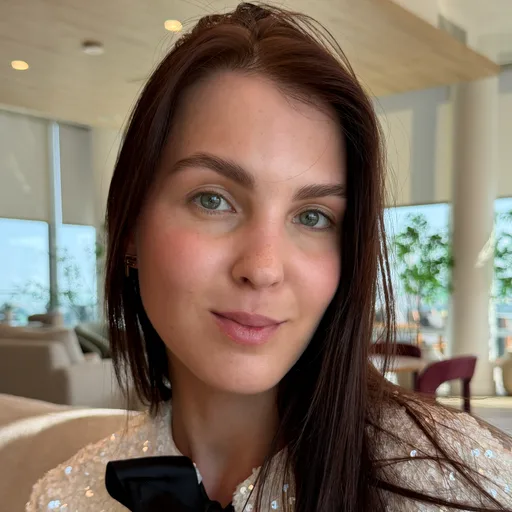
Anastasiia, NYC beauty UGC creator since spring 2026, with a stylist background. I make product videos for beauty, wellness, fashion, home and tech brands, and I write about how the business side actually works.
More about me →